
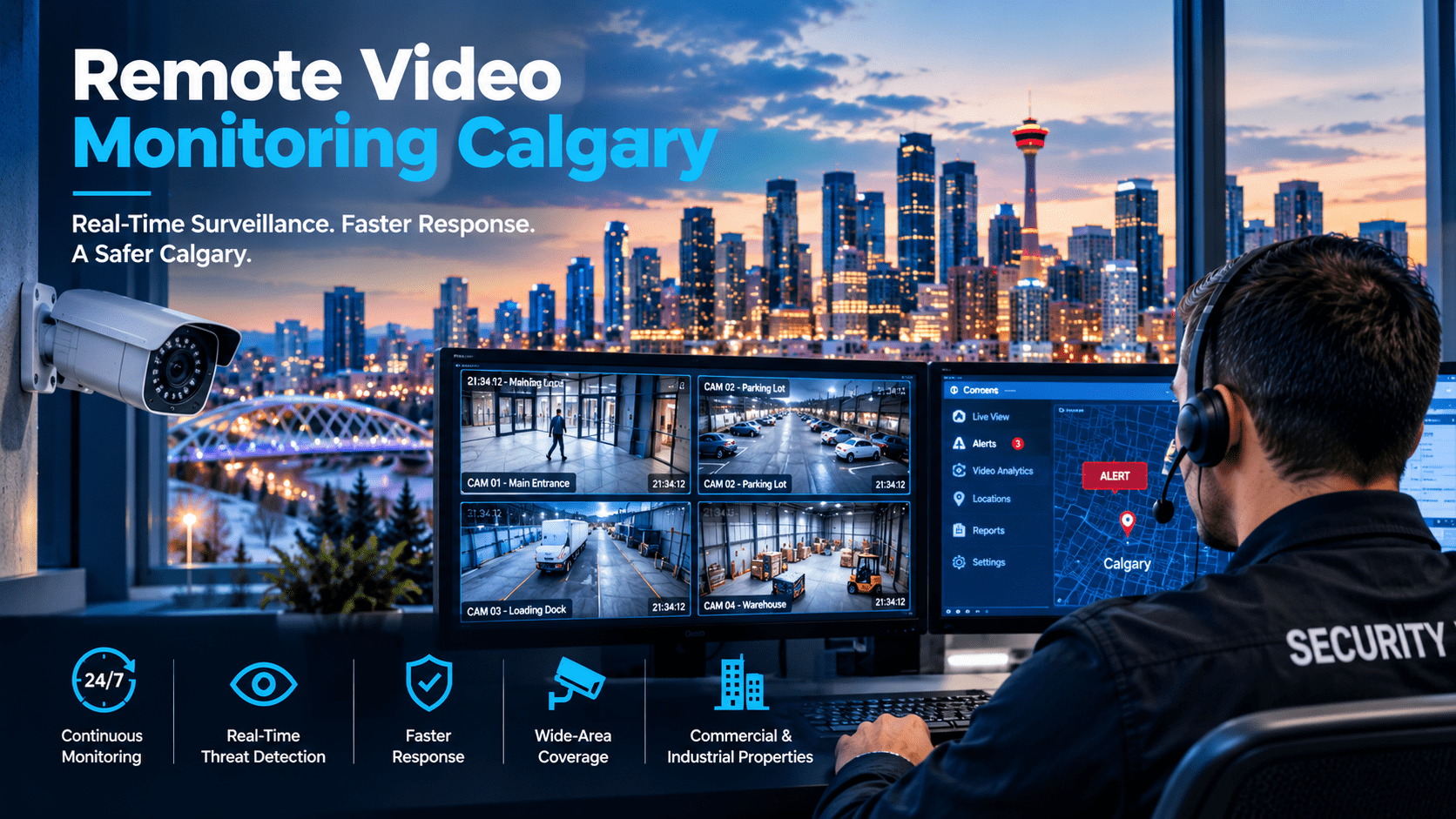
Security threats can happen when a business is closed, employees have gone home, or a property is completely unattended. For Calgary businesses, construction sites, warehouses, retail stores, industrial facilities, and commercial properties, simply installing security cameras may not be enough.
Remote Video Monitoring Calgary provides a more proactive approach to property security by combining surveillance cameras, video technology, remote monitoring professionals, and established response procedures.
Instead of discovering an intrusion after the fact by reviewing recorded footage, remote video monitoring can help identify suspicious activity while it is happening. Depending on the monitoring system and security plan, trained operators can assess activity, issue remote warnings, notify designated contacts, or initiate an appropriate response.
Whether you need overnight protection, construction site surveillance, commercial security, or monitoring across multiple locations, remote video monitoring can help provide greater visibility and peace of mind without requiring a security guard to be physically present at every property.
What Is Remote Video Monitoring?
How Remote Video Surveillance Works
Remote video monitoring is a security service that allows trained professionals to monitor surveillance cameras from a remote monitoring location.
Cameras installed at your property transmit video to the monitoring team. When movement, an alarm, or another predefined event occurs, monitoring personnel can review the available video and determine whether the activity appears routine or potentially suspicious.
Depending on the service, the monitoring team may then follow a predetermined response process.
A typical system works like this:
Security Camera → Video Feed → Alert → Human Verification → Response → Incident Documentation
This combination of technology and human oversight makes remote video monitoring different from a basic CCTV recording system.
Remote Monitoring vs. Traditional CCTV
Traditional CCTV systems primarily record video for later review.
Remote video monitoring adds an active security layer.
With traditional CCTV:
Incident → Recording → Review Later
With remote video monitoring:
Activity → Detection → Verification → Response
This proactive approach can be particularly valuable for properties that remain unattended for long periods.
Why Choose Remote Video Monitoring Calgary?
24/7 Property Visibility
One of the primary advantages of Remote Video Monitoring Calgary is the ability to maintain visibility even when your property is unattended.
Businesses can potentially receive monitoring coverage during:
-
Overnight hours
-
Weekends
-
Holidays
-
Business closures
-
Construction downtime
-
Low-staff periods
This means security does not necessarily stop when employees leave the property.
Real-Time Threat Detection
Recorded footage can tell you what happened.
Remote monitoring can help determine what is happening right now.
Trained monitoring personnel can assess activity such as:
-
Unauthorized people entering a property
-
Suspicious vehicles
-
Perimeter breaches
-
Trespassing
-
Theft attempts
-
Vandalism
-
Unusual after-hours activity
Early detection may give businesses an opportunity to respond before an incident causes significant damage or loss.
Remote Security Without a Constant On-Site Guard
Not every business needs or can afford a security guard physically stationed at its property around the clock.
Remote video monitoring offers another option.
A single monitoring operation can potentially oversee multiple cameras and locations, providing broad surveillance coverage without requiring a dedicated guard at every site.
For some businesses, this can be a practical addition to existing physical security measures.
How Does Remote Video Monitoring Calgary Work?
Step 1: Strategic Camera Installation
The first step is identifying where surveillance cameras are most valuable.
Potential locations include:
-
Entrances and exits
-
Parking lots
-
Loading docks
-
Building perimeters
-
Storage areas
-
Equipment yards
-
Restricted areas
-
Construction zones
-
Warehouses
-
High-value asset locations
Strategic placement is essential because cameras cannot protect areas they cannot see.
Step 2: Secure Video Transmission
The cameras transmit video to the remote monitoring platform.
Depending on the system, video analytics and motion detection can help identify events that require attention.
Step 3: Alerts and Video Verification
When an alert occurs, trained monitoring personnel can examine the video feed.
The purpose is to distinguish potentially serious activity from normal events.
For example, an alert might be caused by:
-
An employee working late
-
An authorized delivery
-
Weather conditions
-
Wildlife
-
A legitimate visitor
-
An unauthorized individual
Human verification can provide valuable context before an escalation decision is made.
Step 4: Remote Intervention
Some remote video monitoring systems include two-way audio.
When appropriate, a monitoring operator may issue a remote verbal warning through speakers installed at the property.
A clear warning that the property is being monitored can sometimes discourage an unauthorized person from continuing.
Step 5: Security Response
If suspicious activity is confirmed, the monitoring provider can follow the property’s established response plan.
Depending on the service arrangement, this could include:
-
Contacting a designated property representative
-
Dispatching mobile security
-
Escalating an alarm
-
Requesting emergency assistance when appropriate
-
Preserving relevant footage
-
Creating an incident report
The exact response process should always be discussed with your security provider before service begins.
Benefits of Remote Video Monitoring for Calgary Businesses
Improved Crime Deterrence
Visible cameras can discourage potential trespassers and criminals from targeting a property.
Remote monitoring adds another level because the cameras are not simply recording activity—they may be actively watched.
Signs, cameras, lighting, remote audio warnings, and professional monitoring can work together as part of a layered deterrence strategy.
Faster Awareness of Security Incidents
A delayed response can allow a minor security incident to become a major problem.
Remote video monitoring can provide earlier awareness of suspicious activity.
For example, if someone enters a restricted area after business hours, a monitoring operator may identify the activity shortly after it occurs rather than waiting until employees return the next morning.
Reduced Dependence on Physical Presence
Business owners and property managers cannot be everywhere at once.
Remote monitoring can provide visibility when you are:
-
At another location
-
At home
-
Traveling
-
Managing multiple properties
-
Outside normal business hours
This makes it particularly useful for businesses with distributed operations.
Protection of Valuable Assets
Warehouses, construction sites, industrial properties, and commercial facilities can contain valuable equipment, inventory, tools, vehicles, and materials.
Remote monitoring can help businesses keep watch over these assets when the property is unattended.
Better Incident Documentation
When a security event occurs, video footage can provide valuable information about what happened.
Depending on the system, relevant footage and incident information may be preserved for investigation, insurance purposes, internal reviews, or law enforcement.
Who Can Benefit From Remote Video Monitoring Calgary?
Construction Sites
Construction sites can be highly attractive targets for theft and vandalism because valuable equipment and materials may remain unattended overnight.
Remote video monitoring can help contractors maintain visibility over:
-
Heavy equipment
-
Tools
-
Building materials
-
Site entrances
-
Temporary structures
-
Perimeter fencing
-
Storage containers
For large or remote construction sites, monitored surveillance can become an important part of a broader site-security strategy.
Warehouses and Distribution Centres
Warehouses can contain significant amounts of inventory and expensive equipment.
Remote monitoring can help security teams watch loading docks, entrances, parking areas, storage zones, and building perimeters.
Retail Stores
Retail businesses can use remote video monitoring for after-hours surveillance and protection against theft, vandalism, and unauthorized access.
Cameras can be positioned around entrances, parking areas, inventory rooms, and other sensitive locations.
Industrial Facilities
Industrial properties often have large outdoor areas, equipment yards, restricted areas, and valuable machinery.
Remote video monitoring can provide broader surveillance coverage across these environments.
Commercial Buildings
Office buildings and commercial properties can benefit from monitoring entrances, parking areas, lobbies, restricted areas, and other vulnerable locations.
Property Management Companies
Companies managing multiple properties can use centralized remote monitoring to improve visibility across their portfolio.
Instead of relying entirely on individual site personnel, a centralized monitoring solution can provide another layer of security oversight.
Remote Video Monitoring vs. Security Guards
Understanding the Difference
Remote video monitoring and physical security guards serve different purposes.
A security guard is physically present and can patrol, interact with people, control access, and respond directly to situations on-site.
Remote video monitoring provides surveillance from a distance and can cover multiple areas through strategically positioned cameras.
Neither option is automatically right for every property.
Why Layered Security Can Be Effective
Many businesses can benefit from combining different security technologies and services.
For example:
CCTV Cameras + Remote Monitoring + Mobile Patrol + Access Control
This creates multiple layers of protection.
Remote monitoring can identify suspicious activity, while mobile patrol or on-site personnel can provide physical response when required.
The right combination depends on your property’s risk profile and security requirements.
Key Features to Look for in Remote Video Monitoring
24/7 Monitoring
If your property needs continuous protection, verify that the provider offers monitoring around the clock.
Ask whether overnight, weekend, and holiday monitoring are included.
Human Video Verification
Technology can generate alerts, but human operators can provide additional context.
Ask whether trained personnel review important alerts and determine whether they require escalation.
Video Analytics
Modern systems can use analytics to identify people, vehicles, motion, perimeter activity, or other predefined events.
Analytics can help monitoring personnel focus on activity that may require investigation.
Remote Audio
Two-way or one-way audio can allow monitoring operators to communicate remotely with people at the property.
A remote warning can sometimes act as an effective deterrent.
Alarm Integration
CCTV systems can potentially be integrated with alarm systems.
When an alarm occurs, video can provide additional information to help monitoring personnel assess the situation.
Mobile Patrol Response
If your provider offers mobile patrol services, ask how patrol dispatch works when suspicious activity is detected.
Understand the expected response process before choosing a service package.
Incident Reports
Ask whether the provider creates incident reports and how relevant video evidence is stored and accessed.
Clear documentation can be valuable for property managers and business owners.
How Much Does Remote Video Monitoring Cost in Calgary?
Factors That Affect Pricing
The cost of Remote Video Monitoring Calgary services varies from property to property.
Factors can include:
-
Number of cameras
-
Number of locations
-
Monitoring hours
-
Camera quality
-
Video analytics
-
Existing CCTV equipment
-
Installation requirements
-
Internet connectivity
-
Alarm integration
-
Remote audio
-
Mobile patrol services
-
Video storage
-
Reporting requirements
Because security requirements differ significantly, businesses should request a customized assessment rather than relying on a generic price estimate.
Is Remote Monitoring Cost-Effective?
For some properties, remote video monitoring can provide broad surveillance coverage without the cost of maintaining a dedicated on-site security presence at all times.
However, cost should not be the only factor.
Businesses should evaluate:
-
Coverage
-
Monitoring quality
-
Response procedures
-
Technology
-
Reliability
-
Reporting
-
Scalability
-
Overall security requirements
The goal is not simply to find the cheapest monitoring service but to find an appropriate security solution.
How to Choose a Remote Video Monitoring Company in Calgary
Evaluate Your Property’s Risks
Start by identifying your property’s most vulnerable areas.
Ask:
-
When is the property unattended?
-
Which assets are most valuable?
-
Where have previous security issues occurred?
-
Are there existing cameras?
-
Do you need overnight coverage?
-
Do you need mobile patrol response?
-
Are multiple locations involved?
These answers can help define your monitoring requirements.
Check Existing Camera Compatibility
If you already have a CCTV system, ask whether it can be integrated into the monitoring platform.
You may not need to replace every camera.
Compatibility depends on your existing hardware, recording system, network, software, and monitoring technology.
Understand the Response Protocol
A monitoring company should be able to explain exactly what happens when suspicious activity is detected.
Ask:
-
Who verifies the alert?
-
How quickly is it reviewed?
-
Is remote audio available?
-
Who is contacted?
-
Is mobile patrol available?
-
When are emergency services contacted?
-
How is the incident documented?
Clear answers can help you compare providers more effectively.
Look for Scalable Solutions
Your business may grow over time.
Choose a monitoring solution that can accommodate additional cameras, properties, or locations as your security needs evolve.
Best Practices for Remote Video Monitoring
Position Cameras for Maximum Coverage
Camera placement should focus on areas with the highest security importance.
Entrances, exits, loading areas, parking lots, perimeters, and high-value asset areas should be assessed carefully.
Address Lighting Issues
Poor lighting can reduce the usefulness of surveillance footage.
Night-time lighting should be considered when designing your CCTV system, especially for outdoor areas.
Test Your System Regularly
Cameras, network connections, recording equipment, alarms, and other components should be tested periodically.
A security system is only useful when it is functioning correctly.
Keep Response Information Updated
If the monitoring provider has outdated contact information, response procedures can become less effective.
Review designated contacts and escalation instructions periodically.
Combine Technology With Physical Security
Remote video monitoring works best as part of a broader security strategy.
Consider combining it with:
-
Access control
-
Security lighting
-
Alarm systems
-
Physical barriers
-
Locks
-
Mobile patrols
-
On-site security personnel
Layered security can address vulnerabilities that a single technology cannot.
Is Remote Video Monitoring Worth It?
When It Makes Sense
Remote video monitoring can be particularly valuable when a property:
-
Remains unattended for long periods
-
Contains expensive equipment or inventory
-
Has a large perimeter
-
Operates across multiple locations
-
Has experienced theft or vandalism
-
Requires overnight surveillance
-
Needs additional security without constant on-site staffing
For these properties, real-time surveillance can provide an important additional layer of protection.
A Proactive Alternative to Passive Surveillance
The biggest distinction is simple:
Passive surveillance records events.
Remote video monitoring actively watches for potential security incidents.
For businesses that want to know what is happening at their property—not simply what happened yesterday—remote monitoring can be a powerful security tool.
Frequently Asked Questions About Remote Video Monitoring Calgary
What is Remote Video Monitoring Calgary?
Remote Video Monitoring Calgary is a security service that allows trained professionals to monitor surveillance cameras from a remote location. Operators can review alerts, assess suspicious activity, and follow predefined response procedures.
How does remote video monitoring work?
Security cameras transmit video to a remote monitoring platform. When activity triggers an alert or meets predefined criteria, monitoring personnel can review the video, verify the event, and take action according to the property’s security protocol.
Is remote video monitoring available 24/7?
Many professional security providers offer 24/7 remote video monitoring. Businesses should confirm the provider’s monitoring hours, response procedures, and service coverage before signing an agreement.
Can remote video monitoring prevent theft?
No security system can guarantee that theft will never occur. However, visible cameras, active monitoring, remote intervention, and appropriate response procedures can help deter unauthorized activity and potentially enable faster intervention.
Can I use my existing CCTV cameras for remote monitoring?
In some cases, existing cameras can be connected to a remote monitoring service. Compatibility depends on the camera hardware, recording system, network infrastructure, software, and monitoring platform.
Is remote video monitoring suitable for construction sites?
Yes. Construction sites can benefit significantly from remote monitoring because tools, equipment, materials, and vehicles may remain unattended outside working hours.
Can remote video monitoring replace security guards?
Remote video monitoring does not necessarily replace physical security personnel. Instead, it can complement guards and mobile patrols by providing continuous visual surveillance and helping identify situations that may require physical response.
What businesses benefit most from remote video monitoring?
Construction companies, warehouses, industrial facilities, retail stores, commercial buildings, parking facilities, property management companies, and businesses with multiple locations can all benefit from remote video monitoring.
What should I look for in a Calgary remote video monitoring provider?
Look for reliable monitoring coverage, trained operators, clear response procedures, compatible technology, video verification, remote audio capabilities, alarm integration, incident reporting, mobile patrol options, and scalable services.
Conclusion: Strengthen Your Security With Remote Video Monitoring Calgary
Security doesn’t have to stop when your employees leave.
Remote Video Monitoring Calgary gives businesses a way to maintain surveillance and security awareness even when their properties are unattended. By combining CCTV technology, video analytics, trained monitoring personnel, real-time verification, and appropriate response procedures, businesses can move beyond passive surveillance toward a more proactive security strategy.
Whether you operate a construction site, warehouse, retail store, industrial facility, commercial building, or multiple properties, remote video monitoring can help provide greater visibility and an additional layer of protection.
The right solution starts with understanding your property’s vulnerabilities and selecting a monitoring system designed around your specific needs.
Ready to improve your property’s security? Contact a professional Calgary remote video monitoring provider today to discuss your surveillance requirements and request a customized security assessment.