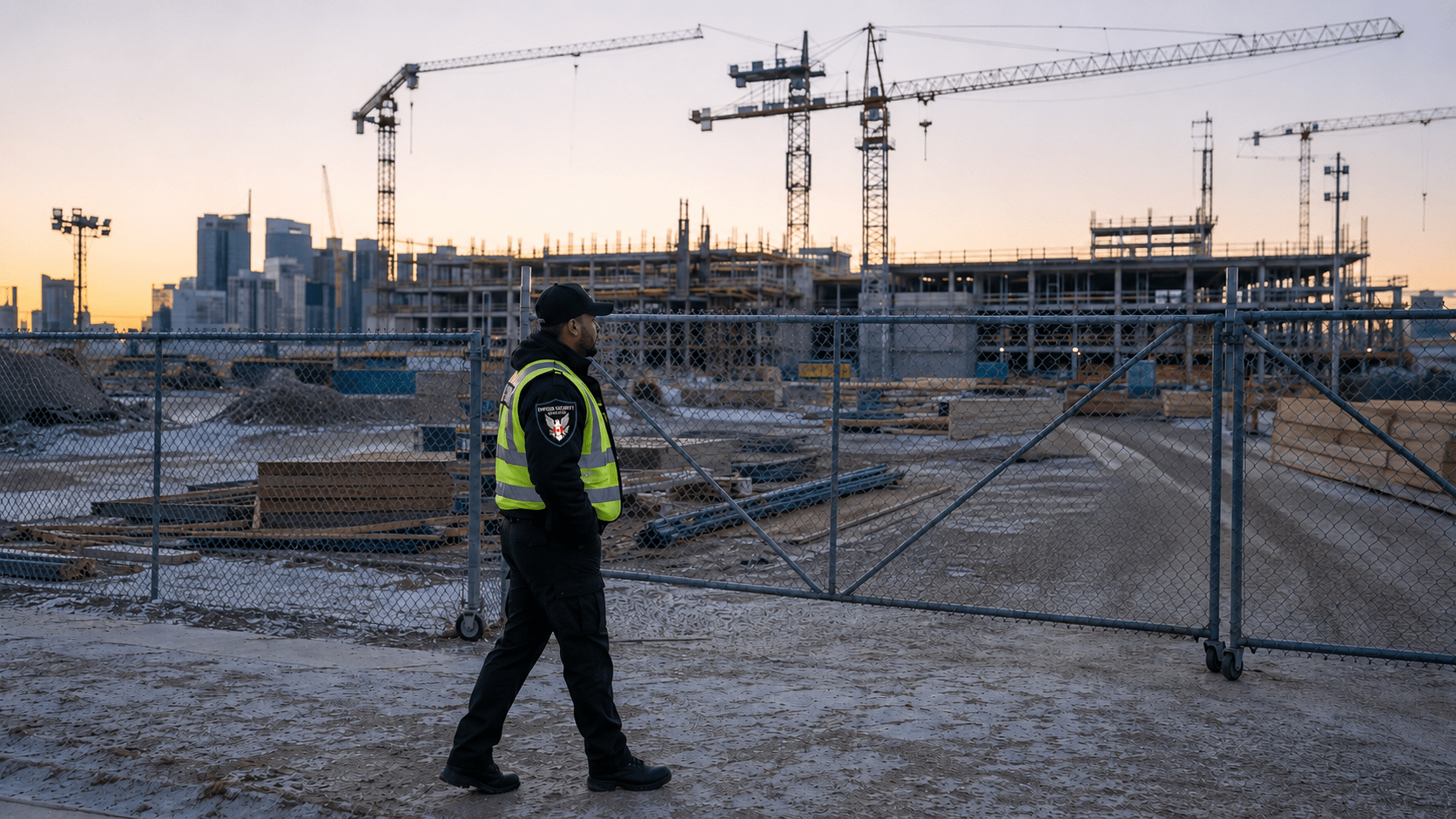
Construction Site Security
Every construction project starts with a schedule, a budget, and a plan. But it only takes one night of theft, vandalism, or unauthorized access to throw that plan off course.
Construction sites are among the most frequently targeted properties because they contain valuable equipment, building materials, temporary infrastructure, and often remain unattended outside working hours. A single incident can delay inspections, interrupt subcontractor schedules, increase insurance claims, and add unexpected costs that affect the entire project.
At Enfield Security Services, we provide specialized Construction Site Security in Calgary for builders, developers, general contractors, infrastructure companies, municipalities, and industrial projects. Our security programs are designed around how active job sites actually operate—not around a one-size-fits-all guard schedule.
Rather than placing a security guard at the entrance and hoping for the best, we evaluate your site’s layout, construction phase, asset locations, delivery schedules, workforce movement, and surrounding environment to create a security plan that adapts as your project evolves.
Whether you’re building a residential subdivision, commercial office, warehouse, healthcare facility, school, roadway, or mixed-use development, our licensed security professionals help protect your project from groundbreaking to final handover.
Construction Site Security Is More Than Preventing Theft
Many companies believe construction security is simply about stopping someone from stealing tools.
In reality, a construction site faces dozens of different security risks every week.
Some risks come from outside the site, while others happen because of changing site conditions, multiple contractors, unsecured deliveries, poor lighting, or temporary access points created as the project progresses.
Effective construction security is about managing all of these moving parts together.
A well-designed security strategy helps protect:
- Heavy machinery and construction equipment
- Copper wiring and electrical materials
- HVAC units and plumbing supplies
- Building materials waiting for installation
- Fuel storage and generators
- Temporary offices and storage containers
- Contractors, engineers, supervisors, and visitors
- Project timelines
- Insurance compliance
- Company reputation
The goal isn’t simply responding to incidents—it’s reducing the opportunities for incidents to happen in the first place.
Why Construction Sites Become High-Risk Targets
Construction sites are different from finished commercial buildings.
Their layout changes almost every day.
New access routes are created.
Temporary fencing is moved.
Building materials arrive in stages.
Equipment is relocated across the property.
Lighting conditions change.
Subcontractors rotate throughout the week.
These changing conditions create security gaps that experienced criminals often recognize before project teams do.
Instead of random theft, many incidents follow predictable patterns.
For example:
A shipment of copper wiring may arrive several days before installation.
HVAC equipment often remains outdoors until scheduled installation.
Generators, compressors, and skid steers are frequently parked in the same location overnight.
Storage containers may be left unlocked during busy workdays.
Temporary fencing can be removed to allow machinery access and accidentally remain unsecured after crews leave.
Each of these situations creates an opportunity for theft, vandalism, or unauthorized access.
Construction security works best when patrols and monitoring are based on these operational patterns—not fixed schedules.
The Hidden Cost of Construction Site Theft
When expensive equipment disappears, replacing it is only one part of the financial impact.
Most construction companies experience additional costs that are far greater than the value of the stolen asset.
A single theft can result in:
- Delayed inspections
- Missed construction milestones
- Labour downtime
- Emergency material replacement
- Equipment rental costs
- Insurance deductibles
- Project rescheduling
- Supplier delays
- Client dissatisfaction
- Increased future insurance premiums
Even relatively small thefts can affect several subcontractors who depend on the same project schedule.
Protecting a construction site is therefore about protecting productivity—not just physical assets.
Every Construction Phase Requires a Different Security Strategy
One of the biggest mistakes on many projects is using the same security plan from the first day of excavation until project completion.
Construction risks change continuously.
Your security plan should change with them.
Phase 1 – Site Preparation and Groundwork
The first stage of construction often appears low risk because the building has not yet been constructed.
However, this phase usually involves expensive machinery operating in open areas with limited perimeter protection.
Common security concerns include:
- Equipment theft
- Fuel theft
- Illegal dumping
- Trespassing
- Damage to temporary fencing
- Unauthorized vehicle access
During this stage, mobile patrols and perimeter inspections often provide better coverage than relying solely on static guarding.
Phase 2 – Structural Construction
As steel frameworks, concrete structures, and elevated work areas develop, the security landscape changes significantly.
The site becomes larger, more complex, and more difficult to monitor visually.
Risks increase due to:
- Multiple contractor teams
- Increased public visibility
- Temporary access routes
- Crane activity
- Large equipment deliveries
Security priorities include:
- Gate control
- Visitor verification
- Vehicle monitoring
- Perimeter patrols
- After-hours inspections
Phase 3 – Mechanical, Electrical & Plumbing Installation
This stage typically represents the highest financial risk for many construction projects.
High-value materials begin arriving on site, including:
- Copper wiring
- Electrical panels
- Switchgear
- HVAC systems
- Plumbing components
- Mechanical equipment
Because many of these materials remain temporarily stored before installation, they become attractive targets for organized theft.
Security during this stage should include:
- Controlled delivery access
- Overnight patrols
- Live CCTV monitoring
- Storage area inspections
- Material verification procedures
Phase 4 – Interior Finishing
As the project nears completion, expensive finishing materials begin arriving.
These may include:
- Appliances
- Flooring
- Cabinets
- Glass installations
- Interior fixtures
- Decorative materials
At this stage, security focuses less on perimeter protection and more on access control.
Every visitor entering the site should have a legitimate purpose.
Maintaining accurate visitor records becomes increasingly important.
Construction Security Built Around Real Job Site Operations
No two construction projects are identical.
A downtown commercial high-rise operates differently from a suburban housing development.
A warehouse expansion has different security requirements than a highway infrastructure project.
Instead of applying generic security packages, our team studies how your site actually functions.
We evaluate factors such as:
- Site size and layout
- Number of active contractors
- Equipment value
- Material storage locations
- Working hours
- Weekend activity
- Public visibility
- Nearby pedestrian traffic
- Vehicle entry points
- Emergency access routes
- Lighting coverage
- Existing camera systems
- Fence condition
- Historical incident reports
This information helps create a practical security strategy that reflects the realities of your project instead of relying on assumptions.
Security Begins Before the First Guard Arrives
Many security providers focus only on assigning personnel.
Our process starts much earlier.
Before recommending guard hours or patrol frequency, we perform a structured site assessment.
This includes identifying:
- High-value asset zones
- Blind spots around fencing
- Temporary openings created by construction work
- Areas with poor lighting
- Equipment parking locations
- Material delivery zones
- Public access risks
- Emergency response routes
By understanding where vulnerabilities exist, security resources can be deployed where they provide the greatest value.
This proactive planning often reduces unnecessary guard hours while improving overall site protection.
Why Builders Across Calgary Invest in Professional Construction Site Security
Professional construction security is not simply an additional project expense.
For many developers and contractors, it is an investment in project continuity.
A properly secured site helps reduce:
- Theft-related delays
- Equipment replacement costs
- Workplace disruptions
- Insurance complications
- Unauthorized access
- Safety incidents
- Property damage
- Project downtime
More importantly, it gives project managers confidence that the site remains protected even after crews leave for the day.
Our Construction Site Security Services
Every construction project operates differently. A downtown commercial tower has different risks than a residential subdivision, bridge project, warehouse expansion, or industrial facility. That’s why we don’t offer fixed security packages. We build a security strategy around your project’s size, construction phase, workforce, valuable assets, operating hours, and site layout.
Our integrated construction site security services help reduce theft, unauthorized access, vandalism, safety risks, and costly project delays while providing clear communication with your project management team.
Licensed Construction Security Guards
Construction sites require security officers who understand active job sites, contractor movement, equipment protection, and emergency procedures.
Our licensed security guards become an extension of your project team, maintaining a visible presence while following site-specific security protocols.
Our officers are trained to:
- Control site entry and exit points
- Verify contractors, suppliers, and visitors
- Monitor construction activities for suspicious behavior
- Conduct routine perimeter inspections
- Secure storage compounds
- Enforce site access procedures
- Report safety concerns observed during patrols
- Respond to emergencies according to project protocols
- Maintain professional incident documentation
- Coordinate with project managers when unusual activity occurs
Rather than simply remaining at one entrance, our officers actively monitor changing site conditions throughout their shift.
Mobile Patrol Security for Large Construction Sites
Large construction projects often cover several acres, making continuous static guarding both inefficient and expensive.
Mobile patrol security allows trained officers to inspect multiple high-risk locations during every patrol while varying routes and inspection times.
Unlike predictable hourly rounds, randomized patrol schedules make it significantly harder for criminals to identify security gaps.
Our mobile patrol officers inspect:
Site Perimeter
- Temporary fencing
- Construction barriers
- Emergency exits
- Vehicle gates
- Pedestrian access points
Equipment Storage Areas
Officers verify that:
- Heavy equipment remains in designated locations
- Machinery has not been tampered with
- Fuel storage areas remain secure
- Portable equipment is properly stored
Material Storage Zones
Patrols include inspections of:
- Copper wire storage
- Lumber compounds
- Steel storage
- Roofing materials
- Electrical equipment
- Mechanical components
- Plumbing supplies
Temporary Buildings
Regular inspections cover:
- Site offices
- Storage containers
- Tool cribs
- Portable washrooms
- Generator enclosures
Each patrol is documented with time-stamped reports that help project managers verify site activity throughout the day and night.
Live CCTV Monitoring That Goes Beyond Recording
Installing cameras alone doesn’t stop theft.
Most construction cameras simply record events after they happen.
Live CCTV monitoring adds another layer of protection by allowing trained operators to identify suspicious activity as it develops.
When unusual movement is detected, the monitoring team can assess the situation and initiate the appropriate response without waiting until the next morning.
Live monitoring is especially valuable for:
- Overnight protection
- Weekends
- Public holidays
- Vacant job sites
- High-value material deliveries
- Remote construction locations
Combining CCTV with mobile patrols provides broader coverage than relying on either solution alone.
Access Control That Keeps Your Site Organized
Construction sites often involve dozens of subcontractors, suppliers, inspectors, consultants, and visitors arriving throughout the day.
Without proper access control, it becomes difficult to know who is on-site and whether they are authorized to be there.
Our access management procedures help maintain an organized and secure work environment.
Typical access control services include:
- Contractor verification
- Visitor registration
- Delivery confirmation
- Vehicle entry logging
- Temporary visitor badges
- Restricted area management
- After-hours authorization checks
Well-managed access records also support project investigations if an incident occurs.
Equipment & Heavy Machinery Protection
Heavy equipment is one of the largest investments on any construction project.
Excavators, loaders, skid steers, aerial lifts, compactors, and generators often remain on-site overnight, making them attractive targets for theft and vandalism.
Our officers inspect equipment during patrols by checking:
- Equipment parking locations
- Visible signs of tampering
- Fuel security
- Access points
- Temporary locks
- Equipment movement outside scheduled work hours
If suspicious activity is identified, immediate reporting procedures help reduce potential losses.
Protecting High-Value Building Materials
Many construction thefts occur before materials are installed—not after.
Items such as copper wiring, HVAC systems, plumbing fixtures, electrical panels, windows, and specialty finishes often remain on-site for several days.
These delivery windows create opportunities for organized theft.
Our security plans help reduce this risk through:
Delivery Coordination
Security officers verify scheduled deliveries and identify unexpected arrivals.
Secure Storage Monitoring
High-value materials are regularly inspected during patrols.
Controlled Access
Only authorized personnel are permitted to enter designated storage areas.
After-Hours Inspections
Storage compounds receive additional attention during evenings, weekends, and holidays.
Preventing Copper Theft Before It Happens
Copper theft continues to affect construction projects because of its resale value and widespread use in electrical and mechanical systems.
Rather than simply reacting after theft occurs, we focus on reducing opportunities.
This may include:
- Increased patrol frequency after electrical deliveries
- Monitoring storage compounds
- Verifying contractor access
- Inspecting temporary fencing near storage areas
- Reviewing overnight activity around material compounds
These practical measures help reduce exposure during one of the highest-risk stages of construction.
Visitor & Delivery Management
Construction sites receive constant deliveries throughout the project lifecycle.
Every delivery introduces temporary security challenges, including open gates, increased vehicle movement, and unfamiliar personnel.
Our officers assist by:
- Confirming delivery schedules
- Verifying supplier information
- Directing vehicles safely
- Recording arrival and departure times
- Monitoring unloading activities
- Preventing unauthorized collection of materials
This creates greater accountability while reducing confusion during busy construction periods.
Emergency Response & Rapid Incident Management
Unexpected situations can occur even on well-managed construction sites.
Our security personnel are trained to respond quickly and professionally to incidents such as:
- Trespassing
- Break-in attempts
- Property damage
- Suspicious vehicles
- Fire alarms
- Medical emergencies
- Equipment tampering
- Unauthorized after-hours access
When required, officers follow established escalation procedures, notify designated project contacts, and coordinate with emergency services.
The goal is to stabilize the situation while minimizing disruption to ongoing construction activities.
Digital Patrol Reports & Incident Documentation
Security is only valuable when there is clear visibility into what happens on your site.
Every patrol and security event should leave a documented record.
Our reporting process includes:
Patrol Logs
Each patrol records:
- Time of inspection
- Patrol route
- Areas inspected
- Observations
- Security concerns
- Actions taken
Incident Reports
If an event occurs, reports include:
- Date and time
- Exact location
- Description of the incident
- Officer observations
- Response actions
- Supporting photographs when appropriate
- Recommended follow-up actions
These reports provide valuable documentation for project managers, insurers, and internal investigations.
Security That Adapts as Your Project Progresses
Construction projects are constantly changing.
New structures are built.
Temporary fencing moves.
Equipment is relocated.
Additional contractors join the project.
High-value materials arrive.
A security plan that worked during excavation may no longer be effective during interior finishing.
For this reason, we regularly review site conditions and adjust patrol routes, guard placement, monitoring priorities, and access procedures as the project evolves.
Instead of using a fixed security model, we provide protection that grows with your project.
Why an Integrated Security Approach Delivers Better Results
No single security measure can protect every part of a construction site.
Visible guards deter unauthorized access, mobile patrols cover large areas efficiently, access control improves accountability, and live CCTV monitoring strengthens after-hours protection.
By combining these services into one coordinated strategy, project owners gain broader visibility, faster incident response, and stronger protection for people, equipment, materials, and project timelines.
Construction Site Risk Assessment Before Security Deployment
No two construction sites face the same risks.
A five-acre residential subdivision on Calgary’s outskirts requires a different security strategy than a downtown high-rise with multiple public access points. That’s why every project begins with a structured site risk assessment before officers are deployed.
Our assessment focuses on identifying vulnerabilities that could lead to theft, unauthorized access, vandalism, or safety concerns.
What We Evaluate During a Site Assessment
Site Layout & Visibility
We analyze how the property is organized, including:
- Building footprint
- Temporary fencing layout
- Blind spots
- Public sidewalks
- Emergency access routes
- Lighting coverage
- Vehicle circulation paths
The goal is to identify areas where unauthorized individuals could enter or remain undetected.
Asset Mapping
Not every part of a construction site carries the same level of risk.
We identify locations containing:
- Heavy equipment
- Copper wiring
- HVAC units
- Electrical panels
- Fuel storage
- Tool compounds
- Temporary offices
- Storage containers
These become priority inspection zones during patrols.
Workforce Activity Analysis
Construction sites change throughout the day.
We evaluate:
- Shift schedules
- Contractor movement
- Delivery windows
- Weekend activity
- Night operations
- High-traffic periods
Security coverage is then aligned with actual site activity instead of fixed patrol times.
Existing Security Measures
Where applicable, we review:
- Existing CCTV coverage
- Alarm systems
- Gate controls
- Access procedures
- Perimeter fencing
- Site lighting
- Signage
Rather than replacing existing systems, we integrate our services to strengthen overall protection.
Calgary Construction Projects Face Unique Security Challenges
Construction security in Calgary is influenced by factors that may not affect projects in other cities.
Rapid urban growth, seasonal weather, large infrastructure developments, and expanding residential communities all create different security demands.
Some projects experience increased pedestrian activity, while others operate in remote industrial areas with limited natural surveillance.
Instead of relying on generic security models, we consider the environment surrounding each project when developing a protection plan.
Examples include:
- Residential developments with public walking paths nearby
- Commercial projects located in busy downtown areas
- Industrial facilities operating around the clock
- Infrastructure projects with multiple public access points
- Large developments covering several acres
Understanding these differences helps ensure security resources are placed where they have the greatest impact.
Seasonal Construction Security Planning
Construction risks don’t stay the same throughout the year.
Weather, daylight hours, project schedules, and material deliveries all influence site security.
Winter
Winter brings longer nights and reduced visibility.
Security priorities include:
- Monitoring snow-covered access points
- Checking gates after heavy snowfall
- Inspecting lighting systems
- Watching for equipment left idle during weather delays
Spring
As construction activity increases, so does site traffic.
Common priorities include:
- Managing new subcontractors
- Monitoring expanding work zones
- Protecting newly delivered materials
- Reviewing changing access routes
Summer
Long daylight hours often mean extended construction schedules.
Security focuses on:
- Increased workforce movement
- Weekend material deliveries
- Temporary storage compounds
- Visitor management
Fall
As projects approach completion, valuable finishing materials arrive on-site.
Additional attention is given to:
- Interior access control
- Appliance protection
- Window installations
- Final equipment removal
Adjusting security strategies throughout the year helps maintain consistent protection despite changing conditions.
Supporting Site Safety & Compliance
Security personnel contribute more than theft prevention.
They also help support organized, controlled construction environments by monitoring access, documenting incidents, and reporting security-related observations.
While safety compliance remains the responsibility of the project owner and site supervisors, our officers can assist by identifying issues such as:
- Damaged fencing
- Unsecured entry points
- Unauthorized visitors
- Suspicious activity
- Open storage compounds
- Lighting failures
Prompt reporting allows project teams to address concerns before they develop into larger problems.
How Security Protects Project Schedules
Construction delays aren’t always caused by weather or labour shortages.
A stolen generator, damaged electrical equipment, or unauthorized entry can stop work across multiple trades.
Professional security helps reduce disruptions by protecting the assets and infrastructure needed to keep projects moving.
Benefits include:
- Fewer theft-related delays
- Better control of site access
- Reduced equipment downtime
- Improved accountability
- Faster incident reporting
- Better coordination during emergencies
Keeping projects on schedule is often just as valuable as protecting physical assets.
Industries We Protect
Our construction site security services support projects of all sizes, including:
Residential Construction
- Housing developments
- Townhome communities
- Multi-family buildings
- Custom home projects
Commercial Construction
- Office buildings
- Shopping centres
- Hotels
- Restaurants
- Mixed-use developments
Industrial Construction
- Manufacturing facilities
- Distribution centres
- Warehouses
- Processing plants
Public Infrastructure
- Schools
- Healthcare facilities
- Roads
- Bridges
- Utility projects
- Municipal developments
Why Project Managers Choose Enfield Security Services
Construction projects demand more than a visible security presence. They require a partner who understands how job sites evolve, how risks change from one phase to the next, and how security decisions affect schedules, budgets, and contractor productivity.
Clients choose Enfield Security Services because we provide:
✓ Licensed and professional security personnel
✓ Construction-specific security planning
✓ Mobile patrols for large projects
✓ Access control and visitor management
✓ Detailed patrol and incident reporting
✓ Flexible security coverage as projects progress
✓ Responsive communication with project managers
✓ Solutions designed around your site—not a standard template
Our objective is simple: help keep your project secure so your team can focus on building.
Request a Construction Site Security Assessment
Every construction project has different challenges, and effective security starts with understanding those challenges before assigning guards or patrols.
Whether you’re planning a new development, expanding an existing facility, or managing a large infrastructure project, our team can help design a security strategy that reflects your site’s layout, operational schedule, workforce, and risk profile.
Contact Enfield Security Services today to discuss your construction project and learn how a tailored security plan can help protect your people, equipment, materials, and project timeline from groundbreaking through completion.
Frequently Asked Questions
How quickly can construction security be arranged?
Deployment timelines depend on project size, location, and staffing requirements. We work with clients to provide coverage as quickly as operationally possible.
Do you provide overnight construction site security?
Yes. We offer overnight security guards, scheduled mobile patrols, and security monitoring for projects that require after-hours protection.
Can security services be increased during high-risk phases?
Absolutely. Coverage can be adjusted as your project progresses, particularly during periods involving valuable material deliveries or increased site activity.
Do security guards check contractor identification?
Yes. Where required, officers can verify contractors, visitors, suppliers, and authorized personnel according to your site’s access procedures.
Can you secure vacant construction sites?
Yes. Projects that are temporarily inactive or awaiting the next construction phase often benefit from scheduled patrols and regular property inspections.
Are security reports provided after patrols?
Yes. Patrol activities and incidents are documented to provide project managers with clear records of security operations.
Can security officers monitor deliveries?
Yes. Officers can verify scheduled deliveries, record vehicle information, and help manage access during unloading.
Do you protect heavy equipment?
Yes. Patrols include inspections of machinery, storage compounds, generators, fuel areas, and other high-value equipment.
Do you work with residential and commercial builders?
Yes. Our services support residential, commercial, industrial, municipal, and infrastructure construction projects throughout Calgary.
Can security services change as the project grows?
Yes. Security plans are reviewed regularly and can be updated to match new construction phases, changing site layouts, and evolving risks.